The Spotted Bush Snake: Misunderstood and harmless
Every so often, someone spots a bright green snake sliding across a wall or sunning itself in a tree and immediately sounds the alarm — “Boomslang!” It’s an understandable reaction, but more often than not, what they’ve actually seen is the spotted bush snake. And despite the confusion, this sleek little reptile couldn’t be more different from its venomous lookalike.
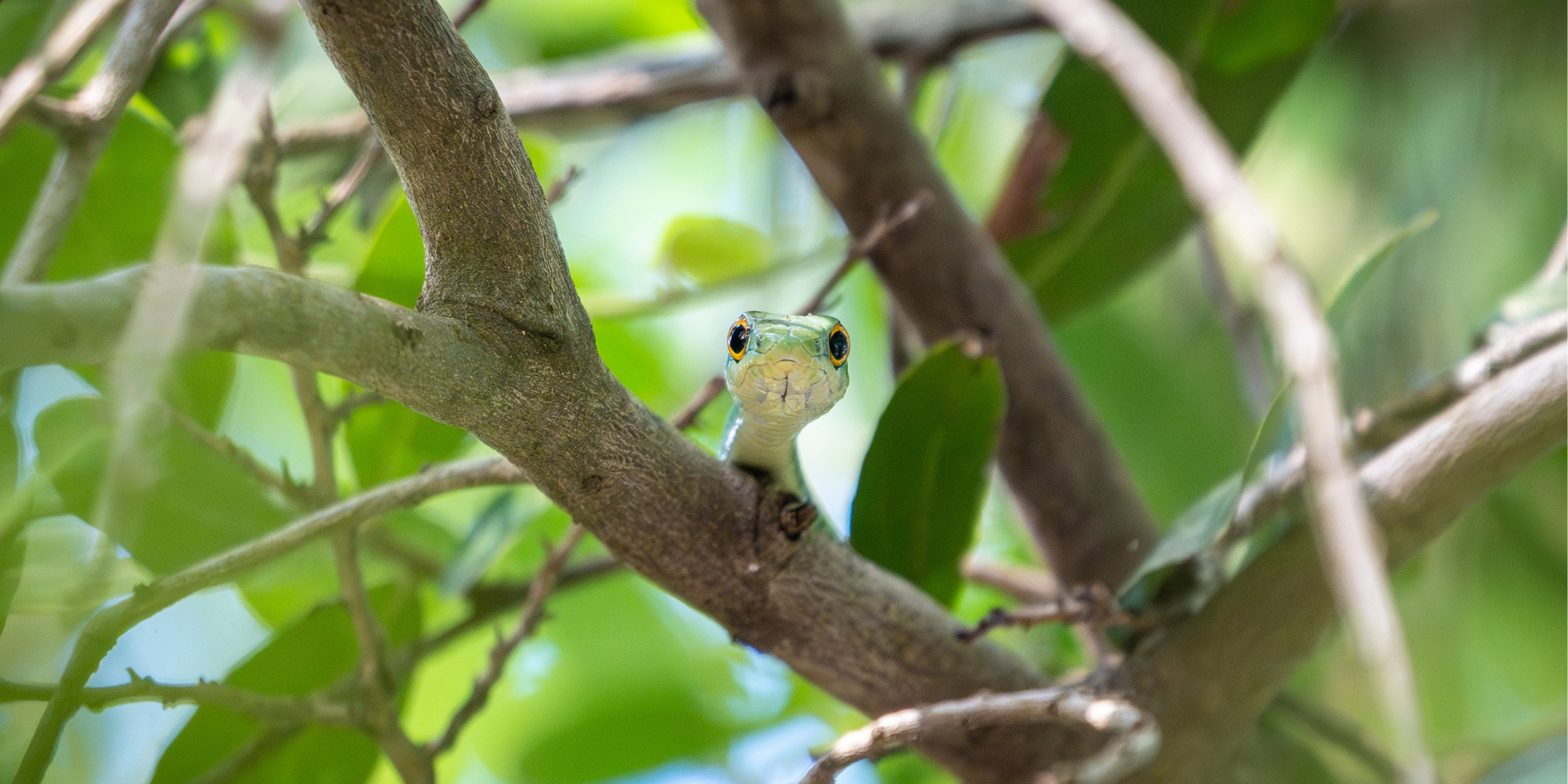
The spotted bush snake (Philothamnus semivariegatus) is one of the most commonly seen snakes in southern Africa, and one of the most misunderstood. It’s completely non-venomous, harmless to people, and actually quite shy. But because it shares that vivid green colouring with the boomslang (Dispholidus typus), it often gets mistaken for one.
Spotted bush snakes are slim, agile, and usually measure around 80 to 100 centimetres in length. Their colour can vary from bright leaf green to a more turquoise tone, often with a scattering of black or blue spots along the body, which is where they get their name. Their eyes are large and golden, with round pupils, giving them a very alert look. They’re diurnal, meaning they’re active during the day, and they’re almost always found in trees, shrubs, or even on walls and roofs where they can chase their favourite prey: geckos and small lizards. Occasionally, they’ll take a frog, but their diet is mainly made up of fast-moving reptiles.
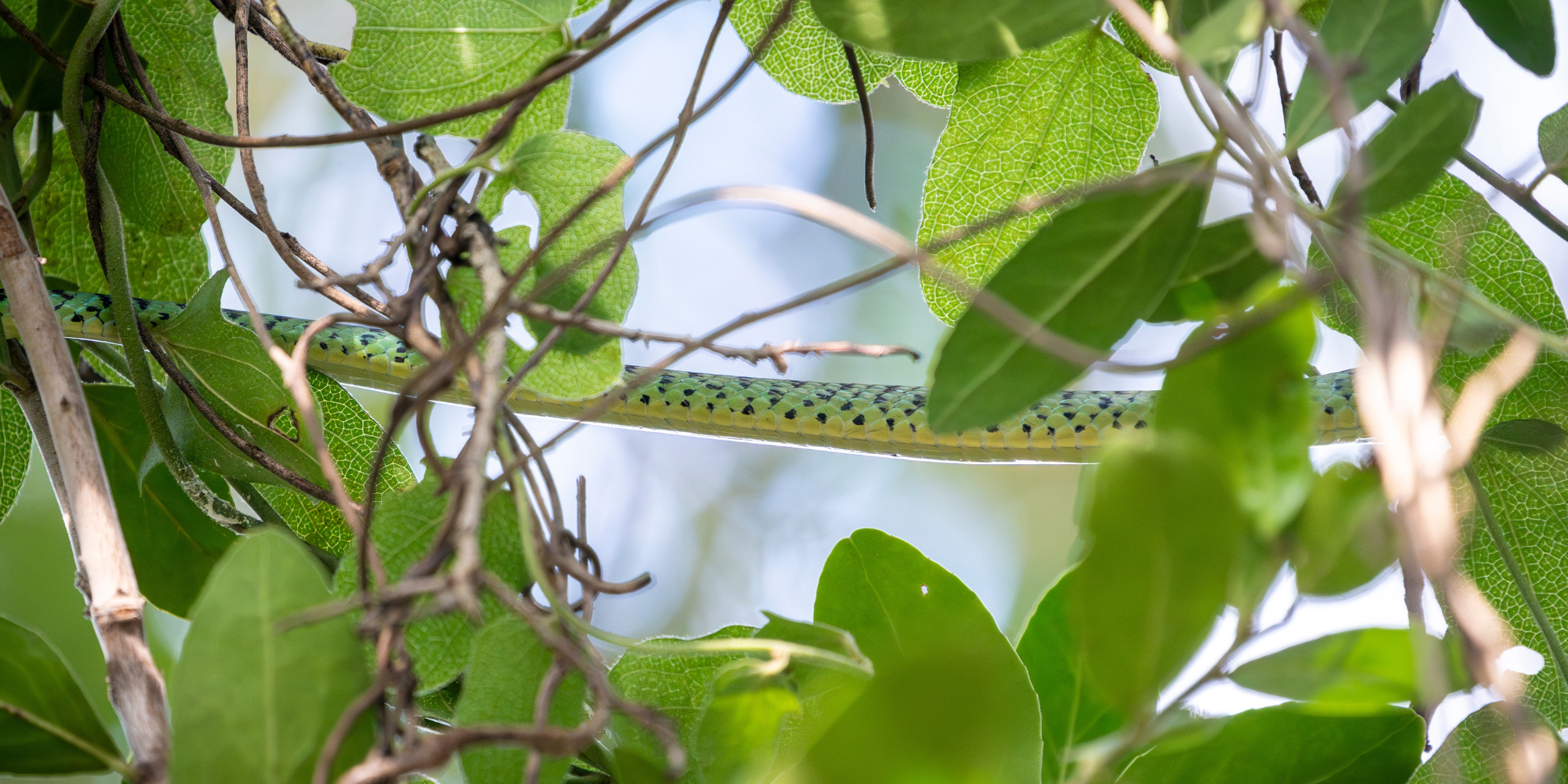
You can find spotted bush snakes throughout most of sub-Saharan Africa. In South Africa, they occur widely across the eastern and northern provinces, KwaZulu-Natal, Limpopo, Mpumalanga and parts of Gauteng, wherever there’s enough vegetation and warmth. They’re particularly common in gardens and around homes that border natural areas, which explains why so many people encounter them without realising what they are.
The boomslang, on the other hand, is indeed one of Africa’s most venomous snakes, and it also happens to be green – at least the males are. But there are a few simple ways to tell the two apart. For one, the boomslang has a noticeably larger head and an extremely large eye relative to its head size. It’s also stockier, with a thicker body and a more defined neck. The spotted bush snake, in contrast, is slender, even delicate, with a more uniform head shape and smaller eyes. Boomslangs also tend to have smoother, shinier scales and a more olive or matte green tone, while spotted bush snakes often have those characteristic dark speckles and a hint of blue.
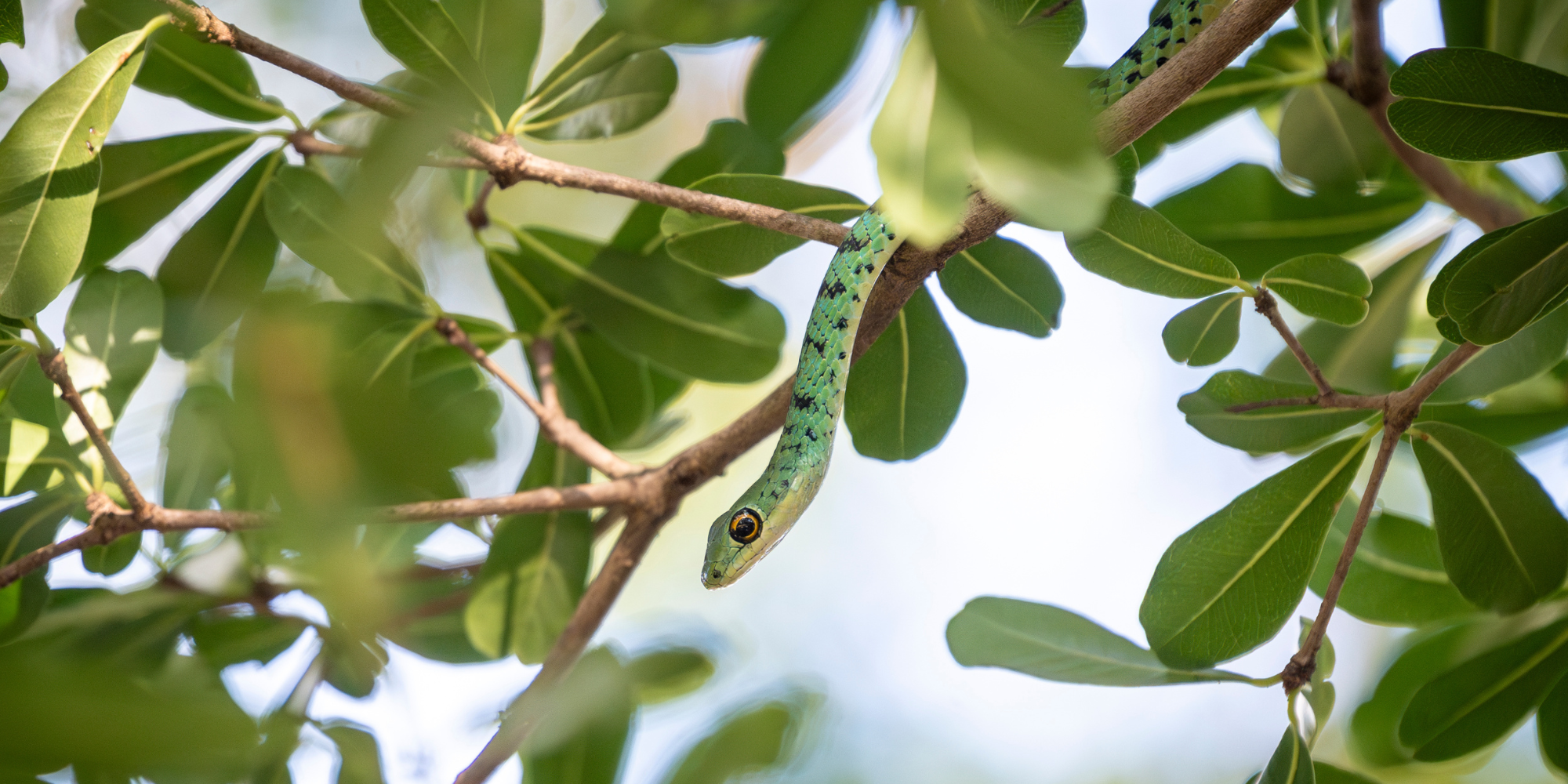
Another key difference is behaviour. Spotted bush snakes are quick to flee and almost impossible to corner. If approached, they’ll zip up a wall, into a tree, or disappear into a gutter. Boomslangs, on the other hand, tend to freeze when threatened, relying on camouflage. And of course, while the boomslang’s bite can be deadly, the spotted bush snake doesn’t possess venom that poses any risk to humans or pets.
Want to learn more about Africa’s wildlife? Bushwise offers wildlife courses that range from a few days to a year.